JOHNNY MORRIS won three full international caps for England in 1949.
The inside forward was spotted whilst playing Sunday school football and became a junior with the then-Manchester United nursery team Mujacs FC in August 1939.
He later turned professional in March 1941 and guested for teams such as Charlton Athletic and Bolton Wanderers during World War Two and was part of the Royal Armoured Corps.
But after falling out with Matt Busby and after 32 goals in 83 league appearances for United, he was sold to Derby County for a then-British record transfer fee of £23,850 in March 1949.
He went on to play 130 games and score 44 goals for the Rams and it was rumoured that Morris was being exchanged for Bolton Wanderers' Harold Hassall early in 1952, but he finally joined Leicester City for £20,000 in October 1952, making 206 appearances and scoring 33 goals.
He joined Corby Town as their player-manager in June 1958.
The Steelmen had just taken the bold step of resigning from the Midland League and were elected to the newly-formed North West zone of the restructured Southern League.
However, his three seasons in charge were hardly glorious – ninth being the highest they achieved, and even the signing of his former Manchester United and England team-mate HENRY COCKBURN failed to ignite the Steelmen.
Cockburn won 13 caps for his country and played over 250 times for United during and after the Second World War.
In the summer of 1961 after leaving Corby, Morris left to play for neighbours Kettering Town under his ex-Leicester City colleague Jack Froggatt.
After hanging up his boots in 1962, Morris joined Southern Premier Division Rugby Town as their manager, before taking up the same position with Great Harwood in 1964 and Oswestry Town in October 1967.
JIM LANGLEY became a legend at Fulham but is also held in the highest esteem by fans of non-League football.
In his youth, he played for a number of sides in his formative years, including Yiewsley, Hounslow Town, Uxbridge and Hayes
In 1946 he joined Brentford on amateur forms and also played for Ruislip and then joined Southern League Guildford City in 1947.
He turned professional with Guildford in 1949 and became a huge crowd favourite, helping them to two Southern League Cup finals in 1951 and 1952 during his four seasons there.
After the near-catastrophic 1948/49 season, he helped the Surrey side to record a top ten finish in each of the following three seasons.
It was hence with great reluctance that Guildford were forced to sell their prized asset to Second Division Leeds United for £2,000 in the summer of 1952 after slipping some £12,000 into debt.
He was not forgotten by the club, however, and in the mid-1970s when Guildford merged with Dorking and were forced to sell their Joseph's Road ground for housing, a Langley Close was created on the site in his honour.
He played only 9 league games for Leeds, scoring 3 times when Brighton signed him for £1,500 in July 1953.
After 178 appearances, when he scored another 16 goals, he joined Fulham in February 1957 for £12,000.
He blossomed at Craven Cottage playing with the likes of Johnny Haynes and Jimmy Hill and made 356 appearances, scoring 33 goals.
And it was whilst with the Cottagers that he made his three England international appearances – all coming in 1958.
He eventually moved to Queen's Park Rangers in June 1965 for £4,000, and made another 87 appearances, netting 9 times.
He then returned to Southern League Premier Division Hillingdon Borough (who were previously known as Yiewsley) as player-manager in September 1967 - a position held until May 1971.
After finishing tenth in his first season in charge, Langley led Boro to runners-up to Cambridge United in 1968/69, sixth the following season but left in May 1971 after they ended in 14th spot and had lost the second-ever FA Trophy Final to Telford United at Wembley – a game he played in at the age of 42!
Langley became coach at Crystal Palace but returned to Hillingdon as club administrator in 1972, filling that role for the next 13 years.
During the era when Tom Finney and Stanley Matthews dominated the winger roles for England, it was to BOBBY LANGTON`s credit that he managed to win 11 caps.
Langton turned professional with Blackburn Rovers, having been signed for £50 from non-League Burscough Victoria as a teenager in 1937.
Within a year he was in the senior side, becoming top marksman with 14 strikes in 37 games as Rovers won the Second Division title in 1938/39.
Then came the war, much of which he spent as an infantryman in India, though some of it he was a guest with Glentoran, helping them to reach the Irish Cup final.
With Finney preferred fleetingly to Matthews on the right flank, England gave Langton his first cap in their opening peacetime international, against Northern Ireland at Belfast in 1946, and he scored in a 7-2 victory.
He retained his place for several matches, thereafter, playing intermittently until winning his last honour in 1950.
By then he had changed clubs, having left Blackburn when they were relegated in 1948 and joined Preston North End in a £16,000 deal.
Langton scored a goal after only 7 seconds of an early game for his new employers but did not settle at Deepdale, Bolton Wanderers paying a club record £20,000 for his services in 1949.
He served the Trotters well, picking up an FA Cup losers' medal against Blackpool in the famous `Matthews Final` of 1953, only for a dispute to result in his return to Blackburn that autumn.
Although now 34, he proved a sound acquisition, contributing fruitfully for three years before a brief spell in Ulster with Ards.
He was then persuaded to join a team of ex-professionals that another former England man, JESSE PYE, had assembled at Southern League Premier Division Wisbech Town.
Langton spent three years with the Fenmen including a short spell at then-Birmingham League Kidderminster Harriers, before returning to his native Merseyside with a stint as boss of his home club Burscough in the Lancashire Combination in 1968 until 1971.
After he died in January 1996, the road that goes past Burscough's ground was renamed Bobby Langton Way after him.
Jesse Pye played only once for England in 1949 against Ireland at Everton.
But he was unfortunate enough to be around at the time when England possessed a plethora of great forwards.
Yet another to have lost some of his prime to World War II, he joined Wolves after peace was declared and spent six years, making 188 appearances and scoring 90 goals in a golden era for the club and he scored twice in the 1949 FA Cup Final win over Leicester City.
But he knew his time at Molineux was coming to an end when they twice tried to use him in exchange deals which he turned down.
He finally left for Luton Town in 1952 and then Derby County, adding a further 120 games to his tally and over 50 more goals.
In 1957 Pye moved to Wisbech and opened several sweet shops in the town.
He signed for Wisbech Town, who were then playing in the Midland League.
Pye scored the goal that beat Colchester United to put Wisbech into the Second Round proper of the FA Cup for the first time in their history in November 1957.
The following season the Fenmen were elected into the Southern League North Western Division and Pye became player-manager in March 1960 and held the post until resigning in April 1967.
During that time, he led Wisbech to promotion to the Southern Premier Division in 1962 but they suffered relegation in 1965.
Pye and Langton were able to attract several more former international stars to the Fens.
BILLY ELLIOTT was another to have played for Wisbech and England.
Elliott, along with Pye and Langton, was seen as one of the greatest players to have ever pulled on a Wisbech shirt.
Elliott mostly played on the left-wing and joined Wisbech in 1959 at the age of 34.
He played his final match for the Fenmen in 1961. They were the last club he played for.
Bradford-born, he played 117 times for Wisbech and scored 18 goals for the club.
After leaving the Fenmen, Elliott pursued a career in management and took charge of the Libyan national team and several club sides, including Darlington and Brann Bergen in Sweden.
He also coached the Sunderland team which won the 1973 FA Cup against mighty Leeds United.
Elliott began his playing career with Bradford Park Avenue, joining as an amateur in 1939 and turning professional in March 1942.
He scored 21 times in 176 league games for Bradford before a £23,000 move to Burnley in August 1951
He made his debut for England in May 1952 in a 1-1 draw with Italy in Florence, also playing in the 3-2 win against Austria in Vienna a week later.
The following season he played games against Northern Ireland, Wales and Belgium.
In June 1953, after 14 goals in 74 league games for Burnley, Elliott moved to Sunderland in June 1953, costing £26,000.
He played 212 games and scored 26 goals, in a six-year spell at the club, before leaving for the Fenmen in 1959.
ARTHUR FITZSIMONS won 26 caps for the Republic of Ireland and he was signed by Jesse Pye for Wisbech in 1961, just two years after his last international appearance.
His career began in his home country with Shelbourne before being signed by Middlesbrough in 1949.
He went on to play 223 times for Boro, scoring 49 goals and laying on many more from the wing or inside forward for a certain Brian Clough!
A short spell with Lincoln City followed the end of his time at Ayresome Park and he then spent three years with Mansfield Town, making 62 appearances with 23 goals.
He was signed by Pye in 1961 and stayed with the Fenmen until 1964 when his coaching career took him to Libya, where he spent five and a half years in Tripoli until Colonel Gaddafi came to power, when he was advised to leave!
He returned to Ireland and became player-coach at Drogheda at the age of 39 before becoming the manager of Shamrock Rovers in 1969.
Defender JOE McDONALD won two full caps for Scotland during the 1955 British Championship (home internationals).
He started his playing career at Falkirk where he was a full-back.
He moved to Sunderland for £7,500 and played over 130 games at Roker Park, before moving to Nottingham Forest where he made a further 100-plus appearances and was an FA Cup winner in 1958/59.
He left Forest in 1961 and joined the `all-star squad` being assembled at Wisbech by Jesse Pye.
McDonald spent just over a year with the Fenmen before moving south to take over as player-manager of Southern League First Division side Ramsgate Athletic.
In August 1965, McDonald was appointed manager of Southern Premier Division Yeovil Town.
But as the country celebrated England winning the World Cup in 1966, storm clouds were brewing at Huish.
Lack of money, low attendances, popular players released and not replaced and local rivals being successful were all testing the skills of McDonald.
Many arguments broke out and the supporters club were in dispute with the football club over numerous issues. It must have been a toxic environment to work in, but in March 1967 McDonald was eventually sacked and replaced by Ron Saunders who, of course, went on to lead Aston Villa to the First Division title and the threshold of the European Cup before resigning ahead of the quarter-finals.
REG SMITH won two caps for England just before the Second World War.
He began his career playing with Hitchin Town in the Spartan League and signed amateur forms with Tottenham Hotspur in 1932.
He also represented Hertfordshire FA, as well as the Spartan League.
He joined Millwall as a professional in August 1935 and made 117 appearances, scoring 21 goals.
After being stationed at RAF Leuchers during WW2, Smith guested for and eventually joined Dundee in March 1946, returning south to briefly become player-manager of the newly-formed Corby Town in June 1948 until the end of the year, then in the Midland League.
He returned to Scotland to manage Dundee United and Falkirk before being appointed manager of Millwall in 1959.
In November 1961, Smith was appointed as the new man in charge of Southern League Premier Division side Bedford Town.
He refused a contract, at least initially, and although he saw his new team start with a 5-2 success against Kettering Town at home, there were to be only two more league wins in the next two months and by the latter part of January, the Eagles were marooned firmly in the relegation places, after six defeats in a row.
However, a 3-0 win at home to Gravesend in January began a run of seven wins in the next eight games which sent the side towards the middle of the table and relative safety.
Smith’s first signing, David Sturrock, who had played for him at Dundee United and had recently left Accrington Stanley shortly before the latter left the Football League. So, started six successful years at the club which saw Sturrock evolve from a right-winger into a deep-lying inside forward or striker and eventually into a midfield ball-winner of some skill and a lot of courage.
The good run of February and March evaporated into an indifferent finish and a final 15th place.
In the close season of 1962, Smith joined several other Southern League club bosses by signing players who were on the transfer lists of Football League clubs at hefty fees.
This had been going on for years due to the Football League’s `retain and transfer` system.
Amongst these arguably `illegal` signings by Smith was Jock Wallace, a Scottish goalkeeper `listed` at £7,500 by West Bromwich Albion.
Wallace played for the Eagles until 1964 before embarking on a successful career in management with the likes of Glasgow Rangers and Leicester City.
And in September 1962, Smith gave a debut to a fair-haired 18-year-old called David Skinn.
This began a career with Bedford that would last until 1978.
During the English summers, Smith normally worked as a coach in South Africa, mainly with the Addington club in Durban.
And he announced at the start of the 1963/64 season that he would be emigrating permanently.
He stayed until Christmas and was replaced by Tim Kelly as caretaker until the end of the season as Bedford had arranged for Basil Hayward, the current manager of Yeovil Town, who would end the season as league champions, to become Smith's permanent successor on a three-year contract and a reputed salary of £40 a week (average earnings at the time were about £23) which was said to make him the best-paid manager in non-League football.
Smith managed Addington and Cape Town Spurs and then Bedford turned to him again, ten years after his first appearance, initially as a caretaker but was appointed permanently in January 1972.
It was to be a brief return, however, and in the summer of 1972, Smith resigned after the club finished 15th and went on to manage Southern League Division One North side Stevenage Athletic in 72/73.
Corby have had several other former internationals over the years.
MARK LAWRENSON is a well-known figure for his punditry on the BBC.
His enjoyed a marvellous career with Preston and Liverpool, making over 500 League appearances, winning five championships, three League Cups, an FA Cup and a European Cup.
He also won 39 caps for the Republic of Ireland.
He briefly tried his hand at management with Peterborough and Oxford United but in July 1990 he made a shock move by signing for Southern League Midland Division side Corby Town as a player.
But, mainly used in a midfield role, he helped the Steelmen to promotion in his first season and remained with them until January 1992 when he finished off his playing days with Chesham United.
JOHN ROBERTSON`s spell with Corby was a brief one, joining at the end of the 1985/86 season in the Southern League Premier Division.
The stocky winger became a huge favourite of Brian Clough`s during around 400 Nottingham Forest appearances when he won the First Division title, two European Cups and two League Cups.
He only won 26 caps for Scotland. It would have been more but for the fact that Clough often pulled him out of squads to keep him fit for his team!
Later in 1986 he became landlord at the Greyhound Aslockton and the pub’s football team zoomed up the Newark Alliance with their new star player!
He then joined Grantham Town as manager Martin O’Neill’s assistant and he followed his former Forest team-mate to great success with the likes of Wycombe, Leicester and Celtic.
HUGH CURRAN won five caps for Scotland between 1969 and 1971.
He was a former Manchester United starlet who returned `home` to Third Lanark in 1962.
But in the summer of 1963, Curran joined the large Scottish contingent at Southern League First Division Corby Town.
He was a sensation for the Steelmen in 63/64 and it came as no surprise to anyone that he was sold to Millwall in the summer of 1964 for £3,000.
He went on to make over 400 League appearances for Millwall, Norwich, Wolves, Oxford United and Bolton Wanderers.
He ended his career with a brief, but fairly unsuccessful spell as player-manager of Southern Midland Division side Banbury United.
EDDIE McGOLDRICK is a player who started and finished his career with non-League clubs.
He was actually in the youth team at hometown club Corby Town before swapping to the equivalent just down the road at Alliance Premier League Kettering Town in 1981.
A pacey winger, he made his Poppies debut as a teenager and went on to make over 100 appearances.
But in August 1984, with Kettering in financial strife, McGoldrick was sold to rivals Nuneaton Borough who, at the time, were managed by Graham Carr and possessed several recent former Poppies players such as Richard Dixey, Derek Duggan and Stewart Hamill.
Then only 19-years of age, McGoldrick had been in the Kettering side for the previous three years and 12 months earlier was interesting Tottenham Hotspur.
He was only at Manor Park for a couple of seasons as he was sold to a Northampton Town side now managed by Carr, for a £14,000 fee.
McGoldrick finally retired from playing professionally in 2000 at the age of 35 after three seasons at Manchester City.
During his 17-year career, he won the Division Four title with Northampton, the Full Members Cup with Crystal Palace and the UEFA Cup Winner’s Cup with Arsenal.
He also represented the Republic of Ireland on 15 occasions and was a member of the 1994 FIFA World Cup Finals squad.
After taking a couple of years out of the game, McGoldrick started his career in coaching when he was appointed manager of his hometown side Corby Town.
He had a reasonably successful spell at Corby taking the team from the bottom of the league to tenth position in his first season, but he left after only a year because of financial constraints.
In 2007, McGoldrick was back in football with Northampton Town first as coach of their academy under-14 side and then their under-16 side.
After spending three years at Northampton, he left to further his coaching career and spent time at Leicester City coaching their elite players on a part-time basis and also spent time working as head coach at an academy in Ghana.
McGoldrick returned to England in 2013 to take up a new post as an academy coach at a Crystal Palace satellite set-up in Northampton.
KEVIN WILSON made 42 international appearances for Northern Ireland between 1987 and 1995 during his time with Derby County and Ipswich Town.
He had actually started his career with Banbury United in the Southern League North before being signed by Derby for £20,000 in 1979.
He went on to make over 600 League appearances and score 149 goals before embarking on a managerial career with Northampton Town, Bedford Town and Aylesbury United in the Isthmian League Premier Division, Kettering Town in both the Isthmian Premier and Conference North and Corby Town in the Southern Premier Division in 2007/08.
More recently he has been in charge of Ilkeston and Nuneaton Town.
GERRY McELHINNEY was another Northern Ireland international to have played for the Steelmen.
The central defender started his career in his home country with Lisburn Distillery before joining Bolton Wanderers in 1980.
He went on to make over 100 appearances for the Trotters and played a similar number of games for Plymouth Argyle and Peterborough United, where injuries affected him, and he was added to the coaching staff in 1991.
But later that year he left Peterborough and returned to playing, joining Southern League Corby Town and later becoming joint-manager alongside former Nottingham Forest defender Bryn Gunn while continuing to play for the team.
The Steelmen finished third in the Premier Division in 92/93 but just two seasons later following a cash crisis that had threatened the club's very existence they were relegated and struggled just to stay in the Southern League.
It appeared that the battle had been lost at the end of 1997/98, but Corby were handed a late reprieve and switched to the Southern Division for the first time.
In 2002, McElhinney became manager of Graham Street Prims in the Central Midlands League Supreme Division where he stayed for four years before leaving in 2006 after a succession of bad results.
After leaving football he returned to Ireland
RAY O`BRIEN began his career with Shelbourne before transferring to Manchester United.
He was then transferred to Notts County in 1974 for £45,000 without making the first team at Old Trafford.
At Meadow Lane, he created a club record in 1979/80 when he became the first full-back to finish as the leading scorer.
He spent ten years at County making over 300 appearances. He also won four caps for the Republic of Ireland, making his debut in March 1976.
He later managed the likes of Boston United and Arnold Town.
DICK WHITTAKER was a right-back who joined Chelsea in 1952.
He played 48 times for Chelsea and was capped once by the Republic of Ireland in 1959 before moving to Peterborough United in June 1960 and from there to Queens Park Rangers.
He joined Corby in 1964 and skippered the side to promotion to the Southern Premier Division at the end of the season and stayed at Occupation Road for three years before retiring.
STAN RICKABY was capped just the once by England in a 1953 World Cup qualifier against Northern Ireland.
The right-back started his career with his local Northern League side South Bank from where he joined Middlesbrough during the Second World War.
Having been stuck in the reserve team, making only 10 first team outings, he signed for West Bromwich Albion in February 1950 for a £7,500 fee.
An injury curtailed his full-time career after 189 appearances and 2 goals for the Baggies.
In July 1955, Rickaby moved south to become player-manager of then Western League club Poole Town.
He led them to runners-up in 1955/56 and the following season the Dolphins won the Western League and they joined the Southern League
He quit as manager at the end of the 1958/59 season after which he played the 59/60 season as a player only.
At the end of the season, he joined Southern Premier Division neighbours Weymouth for another season.
He then spent the 1963/64 season playing with Newton Abbot Spurs in the South Western League.
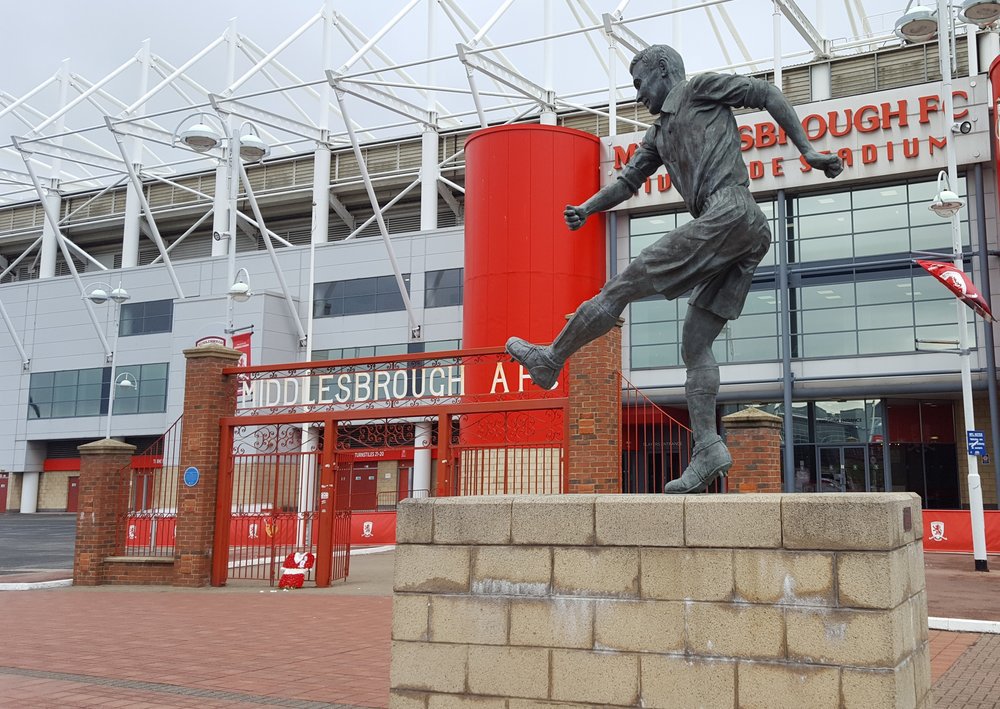
WILF MANNION was good enough and respected enough to have a statue erected outside the Riverside home of Middlesbrough (pictured).
The little inside forward never played at that ground, of course, as he spent his years as a Boro player at Ayresome Park.
Mannion signed amateur, then professional forms with Middlesbrough in September 1936.
He continued to play for Boro in the early years of the Second World War while serving in the Auxiliary Fire Service before being called up.
He appeared as a guest for both Tottenham Hotspur and Bournemouth and also appeared with the South African club Peninsular of Johannesburg whilst serving in that country.
After returning from the war, Mannion clashed with Boro in 1948 over the contract system which chained players to their clubs, often for a pittance.
Despite Arsenal wanting him, he demanded a move to Oldham Athletic, but bosses at the Teesside club put a record £25,000 price tag on him. So Mannion went on strike.
He returned to the Middlesbrough side six months later but announced his retirement from football in June 1954, having played 341 league matches, scoring 99 times and appeared 26 times for England, scoring 11 goals.
In December that year, he returned to the game when he signed for Hull City, who paid Middlesbrough, who still held his registration, the then considerable sum of £4,500.
He played 16 matches for Hull, scoring once, but after some hard-hitting articles that Mannion wrote in his Sunday newspaper column, he was suspended by the Football League who sought to make an example of him.
Undeterred, Mannion took his talents into non-League football with Poole Town in the summer of 1955 after being signed by his former Middlesbrough team-mate Stan Rickaby, originally thrilling supporters of Western League sides before the Dolphins went up to the Southern League.
He later joined Cambridge United, who were initially in the Eastern Counties League and then Southern League, where his presence doubled attendances.
He later ran a pub in Stevenage and worked on an assembly line at Vauxhall Motors plant at Luton.
He returned to the game as player-manager of Lancashire Combination club Earlestown in 1960 before emigrating to Australia.
ALAN SMITH won 13 full international caps for England and is a rarity in that he also won 3 caps for the England semi-professional (now England C) side.
Smith started his career in the Southern League Midland Division with Alvechurch.
The Worcestershire outfit were reigning champions when the 1981/82 got underway – a season that would see the introduction of a Premier Division at its end - and it produced a see-saw battle to retain the championship but Nuneaton Borough finished the stronger to push Alvechurch into the runners-up position.
During that season, after Smith gained semi-pro international honours, he joined Leicester City for a £15,000 fee – a significant amount then.
But after 76 goals in 200 games, Leicester made a considerable profit by selling him to Arsenal for £800,000 where he gained full international honours, made 264 appearances, netting 86 goals and won two First Division titles, an FA Cup, League Cup, and a UEFA Cup Winners` Cup medal.
He is now a regular pundit on TV.
MARK CHAMBERLAIN won 8 caps for England but is perhaps best known these days as the father of Liverpool and England star Alex Oxlade-Chamberlain.
Mark began his career along with his brother, Neville, at Port Vale, where the pair of them became firm favourites of the home fans.
After scoring 18 goals in 96 matches for Vale, Mark made the short move to neighbours Stoke City in August 1982 for a fee of £135,000.
An England Schoolboy and under-21 international, he went on to win the first of his full international caps in his first season at Stoke.
He adapted to the higher level of football with ease, so much so that he added a further 111 league outings and 17 goals to his career total.
Chamberlain signed for Sheffield Wednesday for £300,000 in September 1985 but made as many substitute appearances as he did starts with the Owls.
In August 1988 he switched to the south coast, signing for Portsmouth for £200,000 and it was at Pompey that he played the most games for any one club, racking up 167 appearances, netting 20 goals.
He stayed at Fratton Park until August 1994, when he moved along the south coast to Brighton.
After twelve months at the Goldstone Ground, where he only featured in a handful of games, he linked up Exeter City, thus meeting up again with his former Stoke team-mates, manager Peter Fox and assistant boss, Noel Blake, where he played many games as an attacking full-back, as well as a wide player.
Chamberlain stayed for two seasons at St James`s Park before being released at the end of 1996/97.
He became player-manager of Fareham Town in March 1997 but left at the end of the following season when the club voluntarily dropped out of the Southern League South Division to re-join the Wessex League.
He returned to Cams Alders briefly as manager in 2001.
In April 2008, he accepted an offer to become the assistant coach of the East Timor national team, but six months later he was on coaching staff at Portsmouth.
And finally, for Part Two, NEIL WEBB had one of the shorter spells in the Southern League!
A former England Youth, under-21 and 26-times full international midfielder, Webb started out with his hometown club Reading before transferring to Portsmouth for £83,000 in 1982.
After appearing over 150 times for Pompey, Brian Clough paid over £250,000 for his services and it was at Forest the really blossomed and it prompted Manchester United to pay £1.5m to take him to Old Trafford in 1989.
Despite winning the FA Cup and European Cup Winners` Cup at United, injuries blighted his time there and he eventually returned to Forest in 1922 for £800,000.
He was released from the City Ground in 1996 surprised many by signing for then-Isthmian League First Division side Aldershot Town in September 1996.
He then took over as player-manager of Southern League Division One South side Weymouth in June 1997
But he lasted only 70 days, playing 8 games and scoring 2 goals.
Most clubs are looking for volunteers. Find out more on the button below:
www.PitchingInVolunteers.co.ukAll the news and results in one place.
REGISTER