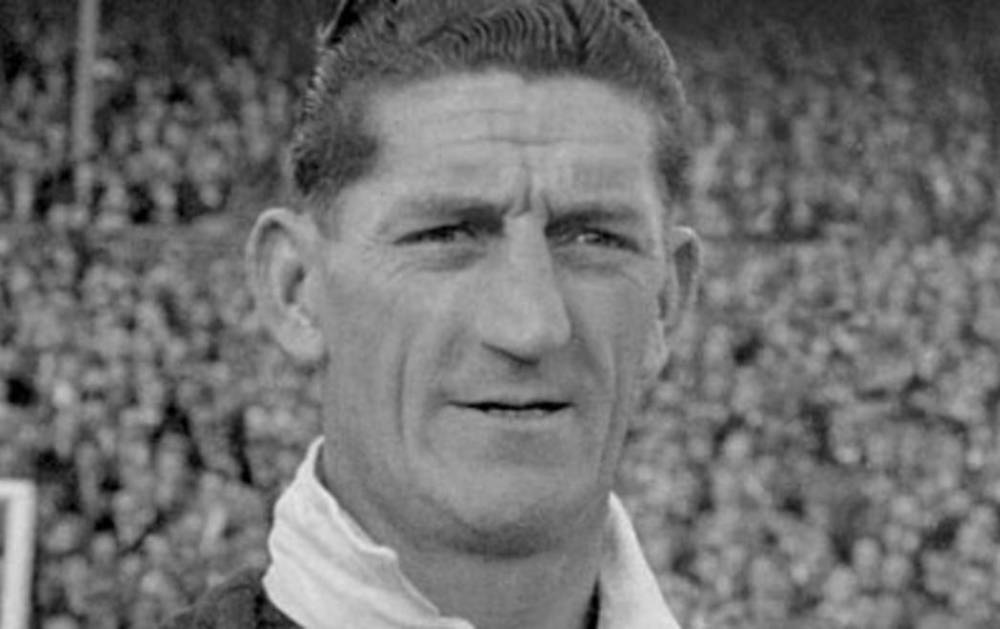
JIMMY KNOX played briefly as a full-time professional with Raith Rovers and Coventry City - making two League appearances for the Sky Blues - before moving into non-League football with Rugby Town, Lockheed Leamington and Corby Town.
He then joined Banbury United for season 1968/69 and made 47 appearances that season, predominantly in the half back line.
After one season at Banbury, he returned to Rugby and then took over as manager of AP Leamington, who he led into the Southern League Premier in 1976 and then in 1978 into the inaugural Alliance Premier League as well as five appearances in the FA Cup First Round.
In September 1980, after a dire opening to the season, a now-named VS Rugby playing in the West Midlands (Regional) League, sacked manager Len Willett and Knox was appointed manager, taking charge from caretaker manager Les Smith at in January 1981.
It was a decision that was to transform the fortunes of the club for just over 11 years.
His reputation enabled him to survive defeats in his first five matches and ten defeats in the first eleven.
The 1981/82 season was a much-improved campaign finishing in a creditable eighth spot as Knox set about building a new team.
Then came 1982/83 when in April 1983 Knox led VS Rugby to success at Wembley in the FA Vase Final beating league rivals Halesowen Town 1-0, amazingly just 27 months after then chairman Mick Vousden had persuaded him to manage his home-town club.
A Valley club that had itself reached such a pinnacle at the end of only its 27th season.
The opportunity to join the Southern League Midland Division ten years after opening the Butlin Road ground was taken, however, it was dependant on the club being able to provide floodlights.
This was achieved in record time being used for the first time in an FA Cup Second Qualifying Round replay against Heybridge Swifts in October 1983 with a 2-0 victory in front of a crowd of 622.
After a gap of ten years, Rugby again had a representative team at Southern League level.
Under Knox, the club moved into the Premier Division after winning the 1986/87 Midland Division championship, won the Southern League Cup and Birmingham Senior Cup, and had memorable FA Cup encounters with Northampton Town, Leyton Orient, Bristol Rovers and Bristol City taking all but Bristol City to a replay.
Knox left Butlin Road in the summer of 1992 with the team third in the Premier Division and the Birmingham Senior Cup again behind the bar.
His departure though led to a rapid decline in the club`s fortunes.
In the summer of 1950, Kent League club Margate appointed ALMER HALL as player-manager.
A diminutive attacker, he began his career with Sussex County Leaguers Southwick where he won honours as a teenager before signing for Brighton ahead of the 1931/32 season.
Although he didn`t make the Seagulls` first-team, he did come to the attention of Tottenham Hotspur, who signed him in October 1934.
He made 21 appearances for Spurs and scored 3 goals before being released at the end of the 36/36 campaign.
He then moved to Southend United when he scored 10 goals from 41 games and joined Bradford City shortly before the outbreak of World War II.
He `guested` for West Ham United during the war and in December 1945, was officially transferred to the Hammers and went on to score 14 goals from 56 appearances.
But in June 1950 he joined Margate as player boss and also acted as a physiotherapist, having qualified during his time at West Ham.
He went on to score 24 goals in 35 games in his first season with `Gate but was troubled by injuries the following campaign but did manage to add 20 games and 7 goals to his tally.
He celebrated his 40th birthday during the 52/53 season but still played when required and made a dozen appearances with 5 goals.
Margate weren`t that successful during Hall`s time as player-manager, being runners-up in the Kent Senior Shield in his first season in charge and then won the Kent League Cup and finished runners-up in the Kent League in 53/54.
Southern League football returned to Hartsdown Park in the 1959/60 season when the expansion of the league led to a mass exodus from the Kent League, causing it to fold.
Hall`s side just missed out on promotion to the Premier Division in 61/62 but the following season Margate won Division One and also triumphed in the Kent Floodlit Cup and Kent Senior Shield.
In 64/65, Margate took the bold decision to turn full-time and Hall`s men achieved their best-ever league position of sixth.
However, the following campaign was a disaster and Margate finished bottom of the Premier Division and were relegated, having failed to win a single away game in 65/66.
This led to the full-time policy being scrapped and Margate became a semi-professional club again.
The 66/67 season was a far better one for Hall`s side as they finished runners-up to neighbours Dover and so immediately made it back to the Premier Division.
Centre-forward Dennis Randall set a new club goalscoring record that season, finding the net on 54 occasions.
In 67/68 Hall`s side won the Southern League Cup after an epic three-game final against neighbours Ramsgate, but the following season saw Margate struggle and only avoided relegation on goal average.
Another poor campaign followed in 69/70 and Almer Hall stepped down as manager after 20 years in charge and was replaced by Gerry Baker as player-manager.
LIONEL SMITH joined Arsenal in 1939 just before the outbreak of the Second World War as an amateur left-back and signed professionally in August on the eve of the declaration of war.
With football suspended Smith served his country in the Royal Engineers and played for Arsenal 17 times in the wartime league.
After the war he played 181 times starting with one match at centre-half in the championship-winning side of 1947/8.
It was quite a match too – the 8-0 victory over Grimsby Town in May 1948. He then went on to play 32 games in the following season at left-back.
He played all the cup games of 1951/52 when Arsenal lost in the FA Cup Final and made 31 appearances in the championship-winning side of 1952/53.
He won six caps for England starting with the game against Wales in November 1950.
In June 1954, after a season in which he made only a handful of appearances he moved to Watford.
After one year at Watford, Smith then became player-manager at Gravesend & Northfleet in May 1955 as player-manager.
It was following Smith's appointment that the club began to reach its potential.
Smith drafted in former team-mate Jimmy Logie from the Gunners in what was a massive coup for the Fleet at the time.
An outstanding Scottish international inside-forward, Logie, who made 296 appearances for the Highbury outfit, scoring 68 goals, sensationally took a £1,000 signing-on fee to join Gravesend when in dispute with Arsenal.
Logie, together with players such as Eric Day, a winger with almost 400 appearances for Southampton and 148 goals, Jimmy Scarth, formerly with Spurs and Gillingham and an inside forward who went on to become a stalwart for the Fleet with almost 200 appearances and 64 goals, and Bob Thomas, who played almost 300 games for Fulham and Crystal Palace, joined from league rivals Kettering Town where he had played under Tommy Lawton, helped the Fleet lift the Southern League title in 1957/58, the star-studded and attacking side scoring 135 league and cup goals along the way.
They were runners-up the following season, also lifting the Southern League Championship Cup, and crowds of 3,000–5,000 regularly flocked to Stonebridge Road.
The ageing side's influence began to wane, however, and after a 17th place in 1959/60, Smith called it a day and with the end of his management tenure, so ended the Fleet's first and perhaps most successful era until the 21st century.
Logie replaced Smith but without the same impact.
DUDLEY KERNICK is reckoned to be one of the most successful managers in the history of Nuneaton Borough.
Born in Cornwall, he made his senior footballing debut at the age of 13 for Tintagel in the Cornish League before joining Torquay United as a 16-year-old.
He joined the RAF and played wartime football for Birmingham City and Torquay.
In 1947 Dudley signed for Northampton Town for a fee of £3,000 but was only with the Cobblers for a short spell as he was taken on by Birmingham City.
After Birmingham the Cornishman signed for then non-league Shrewsbury before moving on to Kettering Town and then Brierley Hill.
He joined Nuneaton in September 1953 and became an important part of the side that defeated Watford 3-0 in the FA Cup and took Queens Park Rangers to a replay before narrowly losing out 2-1 at Manor Park.
After leaving Nuneaton he joined Hinckley Athletic, then had a spell with Kidderminster Harriers before becoming youth team coach at Coventry City during the Jimmy Hill era.
Kernick became manager of Southern League Hinckley Athletic in 1959 and got them promotion to the Southern League Premier Division in 1962/63.
He left Hinckley to move into broadcasting before signing a five-year contract with Nuneaton Borough in December 1965, replacing the long-serving Fred Badham, who was appointed as full-time commercial manager.
Kernick guided the club to the Third Round of the FA Cup before they were knocked out by Rotherham United after a replay.
In March 1970, Kernick handed over the team duties to Malcolm Allen and took over as full-time commercial manager.
Allen, the club’s longest-serving player, became player-coach as the team fought against relegation
Kernick headed up the financial rescue operation – launched when Borough amalgamated its commercial pool with Birmingham City but left the club by mutual consent, believing that they lacked ambition.
In 1970 he joined Stoke City where he was a very successful commercial manager up until 1985 when he moved to the USA.
BASIL BRIGHT was born in Cwmfelinfach in 1932, and soon after leaving school was employed as backroom staff by Ipswich Town at their Portman Road ground.
Bright first came to Southern League club Barry Town at the end of the 1950/51 season playing a handful of games and actually scored a debut goal in the 4–2 loss at home to Worcester City.
After this brief experience, he signed professional forms for Stoke City during the summer of 1951 and went on to play 19 times for Stoke's Central League team during the 1951/52 season.
When Stoke's long-serving manager Bob McGory finally left the club after 17 years in charge in May 1952, Bright was released.
Bright then trialled for two months with Tottenham Hotspur, but soon found himself getting interest from Cardiff City.
When Bright could not agree on terms with the Bluebirds, Barry, under the management of Bill Jones, stepped in to snap up the promising 20-year-old.
Looking forward to developing the youngster, few would foresee that Bright would be associated with the club as a player, player-manager, and manager for a further 26 years! A career that would take him from the peak of Barry's highest achievement, to the depths of its worst-ever season on record.
On re-joining the club in November 1952, Bright made his second Barry debut as a right-half away at Tonbridge where he scored in the 5–2 win for the Linnets.
His home debut came a week later when Barry entertained Gravesend & Northfleet at Jenner Park, a game dominated by a Stan Richards hat-trick in another 5–2 win for the Linnets.
Bright eventually got his Jenner Park debut goal in yet another 5–2 victory, this time against Lovell's Athletic.
Bright missed Barry`s biggest game for some time because of injury, a game which saw over 9,000 spectators swell Jenner Park for a Welsh Cup tie against Cardiff City, which Town lost 3–2.
However, Bright did make 20 appearances throughout the season, and played his part in helping to record Barry's then biggest ever Southern League points haul of 47. He also featured in the 3–0 South Wales and Monmouthshire Cup Final victory over Cardiff City reserves in front of 4,500 fans.
Bright's first full season in 1953/54 saw him clock up 52 first-team appearances in a season that saw Town reach the heady heights of seventh in the Southern League, and also notch up 100 goals in a season for the first time.
This achievement came from the boots of Stan Richards, Bryn Allen, Jim McGhee and to a lesser extent Derek Tapscott, who was transferred to Arsenal for £8,000 earlier in the season.
The season ended with a friendly against IFK Stockholm, the first overseas visitors to Jenner Park.
More firsts came the following season when Barry Town lifted the Welsh Cup for the first time in May 1955 when the Linnets beat Chester City in a replayed Cup Final at Ninian Park. Town also had an excellent end to a good season which saw them again finish seventh in the league on an equal record points tally of 47. The bad times though, were just around the corner.
Season 1959/60 saw Barry relegated from the Southern League Premier Division, a status the club would never get back.
Relegation from the league's top-flight didn't give the club a safe haven, as Barry soon found its way to the lower regions of the First Division and would bounce around the re-election or relegation places until the mid-1970s.
Season 1964/65 saw Bright installed as player-manager, but it was a desperate season with only five semi-pro players on the books, one of whom was local lad, Ken Gully.
A new low was reached in 1966/67 when Bright's youngsters were thrashed 15–0 on aggregate by Bath City in the Southern League Cup, thankfully only 230 souls saw the 5–0 Jenner Park defeat.
It is still the club's biggest ever aggregate loss – despite the European games since – and was the final act in almost 500 minutes of football that saw Town failing to score a single goal.
It only got worse for Bright though. The enforced sale of Gully to Kettering Town came back to haunt the club as the little forward scored all four goals in a Rockingham Road defeat that cost Bright his job.
As the club continued to lurch from crisis to crisis, Bright returned to Jenner Park in time for the 1971/72 season, but he was soon to be made all too aware of the playing standards he had inherited.
It was to be Barry's worst-ever season, collecting only 9 points all season, attendances slumped further to pitiful levels – as the 69 fans who attended the Dunstable Town game would have testified.
Bright, as a player, had witnessed crowds of 9,000 at Jenner Park, but was now at the helm in front of only 69. With Barry Town in his blood, it must have hurt him as much as it hurt the very few supporters present.
Still, the 20 years of gloom would eventually begin to lift, and Bright was to make some very famous signings. Names such as Mike Cosslett, Tommy Hocking, Mel Donovan, Bobby Smith and Clive Ayres were all signed by Bright, and by the end of the 1975/76 season Town found itself in the middle of one of its best runs of form for 30 years.
The club finished with a record haul of points (48) and finished sixth in the league. It had been a long and difficult journey, but Bright had helped turn the club's fortunes around.
Success brought an increase in spectators through the gates, and by the 1976/77 season a crowd of 3,500 (mostly through clever marketing of free tickets to school children) was at Jenner Park to see a high-flying Barry team take on champions Worcester City, eager to finish a season unbeaten. Bright's men won 3–1 in front of the TV cameras, which no doubt also inspired a pitch invasion from the Town's school population! For Barry, a final league position of fifth place showed what could be done with a settled, talented squad.
In what would be Bright's final season with Barry, the club took off for Scandinavia for a series of pre-season friendlies in which the club performed admirably. One player invited along to be with the team by Bright was young Gavin Price, and though Price returned with Barry he was soon signed by Charlton Athletic.
Although Bright's tenure with Town ended with an acrimonious resignation in April 1978, his legacy lives on in many ways.
RONNIE ROOKE was a natural centre-forward of the old school, strong and bustling with a deadly accurate and fast right foot.
After early outings with Guildford City and Woking, he started his League playing career at Crystal Palace in 1933 without enormous success, only making 18 appearances in three years, but on moving to Fulham in 1936 he found regular first-team football and a high strike rate. He hit 69 goals in 106 peacetime matches for Fulham-including all 6 against Bury in the FA Cup in 1938/39- and in wartime football he averaged a goal a game and won an England cap against Wales at Molyneux in 1942/43.
Rooke (pictured) joined Arsenal in 1946 and was a prolific striker during his two-and-a-half-year spell at Highbury and still holds the club`s post-war goalscoring record for an individual season – Ted Drake`s 42 coming in the 1930s.
Ninety-four starts, 70 goals, a league winners' medal, and a long-standing record later, Rooke transferred to Crystal Palace as player-manager in June 1949 and led them to a respectable mid-table position in the Third Divison (South) in his first season, but the following year they plummeted to the bottom of the table and he left in December 1950.
After being introduced to the crowd as a `guest` at The Eyrie before a Southern League match against Kettering Town in late January 1951, he was appointed player-manager of the club the following month.
His debut in a reserve match attracted a crowd of over 3,000 and his personal reputation and goalscoring revived a club that had struggled since joining the Southern League in 1945.
When he took over the team seemed doomed to seek re-election for the third successive season but in a few weeks, he lifted them into a semi-respectable 17th place.
In 1951/2 they consolidated this into a mid-table placing, their best so far, and reached the First Round of the FA Cup for only the second time, going down honourably at Swindon Town.
In 1952/3 they finished third, missing the title by only two points after being in with a chance of winning it until the last day of the season. However, Rooke’s style was to sign lots of experienced players, often former colleagues from his old clubs, and offer them substantial wages.
By the start of 1953/4 this policy was becoming financially unsustainable and after months of ill-concealed rows, including a very public one at the AGM, in December 1953 he was given leave with pay until the end of his contract the following summer.
Whatever his merits as a manager, his contributions on the field were massive, with 96 goals in 136 competitive senior matches plus a few more for the reserves.
He carried on playing and managing, first at Hayward’s Heath and then at Addlestone.
But in 1959 he returned to Bedford to succeed Tim Kelly – a move which surprised some - especially as several of the directors who had sacked him five years earlier were still on the Board.
He started with a highly successful side and much goodwill but against stronger opposition now that the league had created a Premier Division.
With the exception of the prolific Arthur Hukin, Rooke’s signings didn’t gel with the established players and after a mid-table finish in April 1960 the club’s finances forced the release of Len Duquemin, Micky Bull and Jimmy Clugston, three of the mainstays of the championship-winning side.
Season 60/61 started terribly although there was a revival of sorts after Christmas, but 1961/62 began much the same with a steadily deteriorating standard of players and falling gates.
And after a 2-3 FA Cup defeat at Hitchin Town in September 1961 the Board dispensed with Rooke’s services and he did not manage again.
Despite being nearly 50 when his second spell began, he was still registered as a player, turning out occasionally for the reserves and even, in emergencies, the first team; his final appearance at Yeovil early in 1961 ended in a ten-goal immolition.
BILL LEIVERS was a good, old fashioned full back who began his career with his local side Chesterfield just after the Second World War.
He played 27 times for the Spireites before he moved to Manchester City in November 1953, for a fee of £10,500.
Although he struggled to get in the team at first, he went on to make over 250 appearances, won an FA Cup Final winners` medal in 1956 – the final when famously Bert Trautmann broke his neck - and skippered the side on many occasions in his latter years.
In 1964 he moved to Doncaster Rovers and had a short spell as player-manager.
In 1966 he was offered the managers` role at Fourth Division Workington but wanted to return south and took the post at Southern League Premier Division Cambridge United in December 1967.
Upon being handed the Cambridge post, Leivers apparently told his directors that he expected to win the Southern League title in his first full season, repeat the trick in his second and, in doing so, gain election to the Football League.
Amazingly, he was as good as his word! Two Southern League championships - plus a Southern League Cup - were followed by the battering down of the Football League’s doors and election to the 92 in place of Bradford Park Avenue – and all this within the space of three years, as predicted.
And no one should underestimate the size of the task facing non-League outfits seeking to join the Football League in the late 1960s. There was no automatic promotion to the fourth tier from the ranks below, as there is today.
Entry to this exclusive gentlemen’s club was controlled by an old boys’ network of plutocrats who disdained any change to the status quo – the last election of new blood had been in 1962, when Oxford United profited from the resignation of Accrington Stanley – and the League’s bottom four clubs could almost always rely on a closing of the ranks to guarantee their survival.
United under Leivers gate-crashed this private, old school tie party and then, as if to rub their elders’ and betters’ noses in this upsetting of the natural order, achieved promotion to the Third Division – again within a three-year timespan.
But he was unable to stop them being relegated the following season and he was sacked by United in October 1974 after a disappointing start to the season. He was replaced by a certain Ron Atkinson!
Leivers subsequently managed Chelmsford City between February and December 1975, and in 1979 he returned to the Cambridge area to manage Cambridge City.
During the re-organisation with forming the Alliance Premier League, City were switched from the Southern Division One North to the Midland Division and it`s fair to say that Leivers` sides didn`t enjoy much success until the 1985/86 season when, in their first season at the new Milton Road, they eventually won the Southern Division – having been switched again in 1982.
To pip Salisbury to the title, City had to win on the final day of the season against Waterlooville at home.
Despite going a goal down, the Lilywhites respond with two goals from Martyn Wiles, and a goal each from Gary Grogan and Mario Ippolito which ensured that Leivers had guided City to a dramatic last day championship.
In 1987, he became City's general manager, a position he held until retiring in 1999.
JOHN BARTON became a Worcester City legend both on and off the pitch.
The full back started his career with neighbouring Stourbridge but left in 1976 after the Glassboys had finished bottom of the Southern Premier Division and signed for Worcester, who were in the Division One North at the time.
He helped City achieve promotion in his first season and, under Nobby Clark, finished fourth in 77/78 and City then won the Premier Division title in 78/79, four points clear of Kettering Town.
However, Barton missed the celebrations as he had already been sold to First Division Everton for a then-record non-League fee of £25,000 after City`s win in the FA Cup First Round against Plymouth Argyle.
He stayed at Goodison Park for four years but managed only 20 first-team appearances due to the emerging young talent then at Everton.
He moved to Derby County and made 69 appearances.
In 1985 he returned to the Conference by joining Kidderminster Harriers, helping them to win the FA Trophy in 1987.
He later became assistant manager at Aggborough alongside former Worcester team-mate Graham Allner and worked in a similar role at Nuneaton Borough before becoming manager.
He then managed Southern Premier Division Burton Albion from 1994 until September 1998 and in 1999 he returned to Worcester, this time as boss, ironically taking over from Graham Allner.
When he joined City they were struggling to avoid relegation from the Southern Premier but in 2001 he steered his team to success in the Southern League Cup, and during his five and a half year reign as manager two City players – Adam Wilde and goalkeeper Danny McDonnell – were capped by England at semi-professional level.
In 2004 City became founder members of the Conference North but in January 2005, Barton resigned and another former City player, Andy Preece, took over.
He returned to Worcester briefly as caretaker boss when Preece departed in 2007.
STEVE FALLON was Ron Atkinson`s first signing as a Football League manager.
Fallon was born in Peterborough played for home-town club Whittlesey and for Kettering Town before following Atkinson to Cambridge United as an 18-year-old in 1974.
He went on to make 410 League appearances for United, helping the club to promotions from the Fourth to the Second Division.
Fallon retired from League football in 1986 because of a knee injury and then spent nine years as player-manager of United`s cross-city rivals Southern League Cambridge City.
Fallon had a tough task in succeeding the successful Bill Leivers but his record in the next few seasons was excellent, with City finishing third twice, fifth twice and eighth before a decline began in 1993.
He left City in 1995 and in 1999 took over as manager of neighbouring Histon and led them from the Eastern Counties League Premier Division to the Conference National with a fantastic run.
With a little irony, in December 2006, Histon faced Fallon's former club Cambridge United in the First Round of the FA Trophy - the first competitive match for more than 40 years between the two clubs.
The clubs had been seven divisions apart as recently as the early 1990s and Histon won 5–0!
However, in January 2010 with Histon struggling at the top of the non-League Pyramid, Fallon was sacked a day after being re-instated as manager after being suspended following disagreements with the chairman.
Fallon was appointed manager of Isthmian League North side Soham Town Rangers in March 2012 and stepped down in October 2015 and was then re-appointed as manager of Histon in the same month.
In October 2016 he became director of football, with former goalkeeper Lance Key replacing him as manager.
MARTYN ROGERS is known as `Mr Tiverton Town` and quite rightly so.
Originally with Bristol City, the full back then spent five years with Bath City before returning to the full-time ranks with Exeter City in 1979.
He went on to make 131 appearances for the Grecians before joining Conference side Weymouth in 1986.
He played over 150 times for the Terras – many as a team-mate of brother Peter – before signing for Tiverton as player-manager, taking over from John Owen in the summer of 1991.
The following season the club were runners-up in the Western League to an invincible Clevedon Town and reached the FA Vase Final at Wembley on the back of some staggering results against higher opposition.
Forest Green Rovers were hit for six while Barton Rovers and Buckingham Town both went for four in what was by far Tivvy’s best season to date.
The day out at Wembley lost a little of its silver lining as Town were defeated 1-0 by Bridlington, but by now everything was in place and the remarkable rise of a club that was in danger of extinction ten years prior was about to be completed.
The Western League championship finally arrived at Ladysmead in 1994 and stayed in Tiverton the following year. By this time Tivvy had made three appearances in the First Round proper of the FA Cup, playing host to Leyton Orient and having the cheek to take an early lead on the most recent occasion.
But it was the FA Vase that was most coveted, and Rogers carefully assembled a squad with the belief and talent to succeed, and the dream was finally realised when Tow Law Town were defeated by a single Peter Varley goal at Wembley in May 1998.
Not satisfied with just one trip up the 39 steps to lift the cup Tiverton went and did it again the following year, this time getting the better of a highly fancied Bedlington Terriers side thanks to Scott Rogers late, late strike.
The only thing left was to take on the challenge of the Southern League, and after an impressive initial season Tiverton won promotion to the Premier Division at only the second attempt.
The step up in class did little to temper the Yellows appetite for success and the next two seasons saw them finish respectably in sixth and then fourth, only being denied a shot at the Conference after failing to win any of the last five games of the 2002/03 campaign.
But the latter half of the following season saw Tiverton slump from second to 15th and miss out on a place in the newly structured regional sections of the Conference.
The next five years saw Tivvy back in mid-table, and a particularly frustrating 2006/07 had them fighting at the wrong end of the table for much of the season, often hampered by postponed games, injuries and suspensions. The only high point was winning Southern League Cup with a fine 3-2 aggregate victory over Hemel Hempstead Town, but even that failed to disguise the fact that there needed to be a period of rebuilding if Tiverton are to take the next step up the ladder.
The culmination of half a decade of struggle came in the 2009/10 season when the club finished in the relegation zone.
Tivvy were lucky to escape the drop due to off-field matters concerning other clubs across the non-League system, and in May 2010 Rogers stepped down as manager, bringing to an end a marvellous 19-season managerial tenure.
However, in January 2011, Rogers returned to management when he returned to manage struggling Weymouth and successfully guided the Terras away from the Southern League Premier Division relegation zone by just two points, despite having a ten-point deduction. But he left Weymouth in May 2011 after failing to agree on a budget for the following season.
In August 2012, Rogers joined Southern League Division One South & West side Taunton Town as assistant-manager after two years out of the game.
And then he returned for his second spell in charge of Tiverton in 2014 – a role he still holds.
Most clubs are looking for volunteers. Find out more on the button below:
www.PitchingInVolunteers.co.ukAll the news and results in one place.
REGISTER